Introduction
Reading is a primary channel of learning in college. Professors expect students to be able to read and understand complex written material, often with little guidance or in-class discussion. Further, they may expect students to form their own perspectives on the material, draw connections to other readings or ideas, or apply the concepts they learned to solve problems or interpret phenomena.
To be successful in college and their professions, students need to learn to read actively, which means to read critically, deeply, and creatively.
Workshop Outcomes
Students will leave this workshop
- With a handout detailing the steps of a robust active reading process
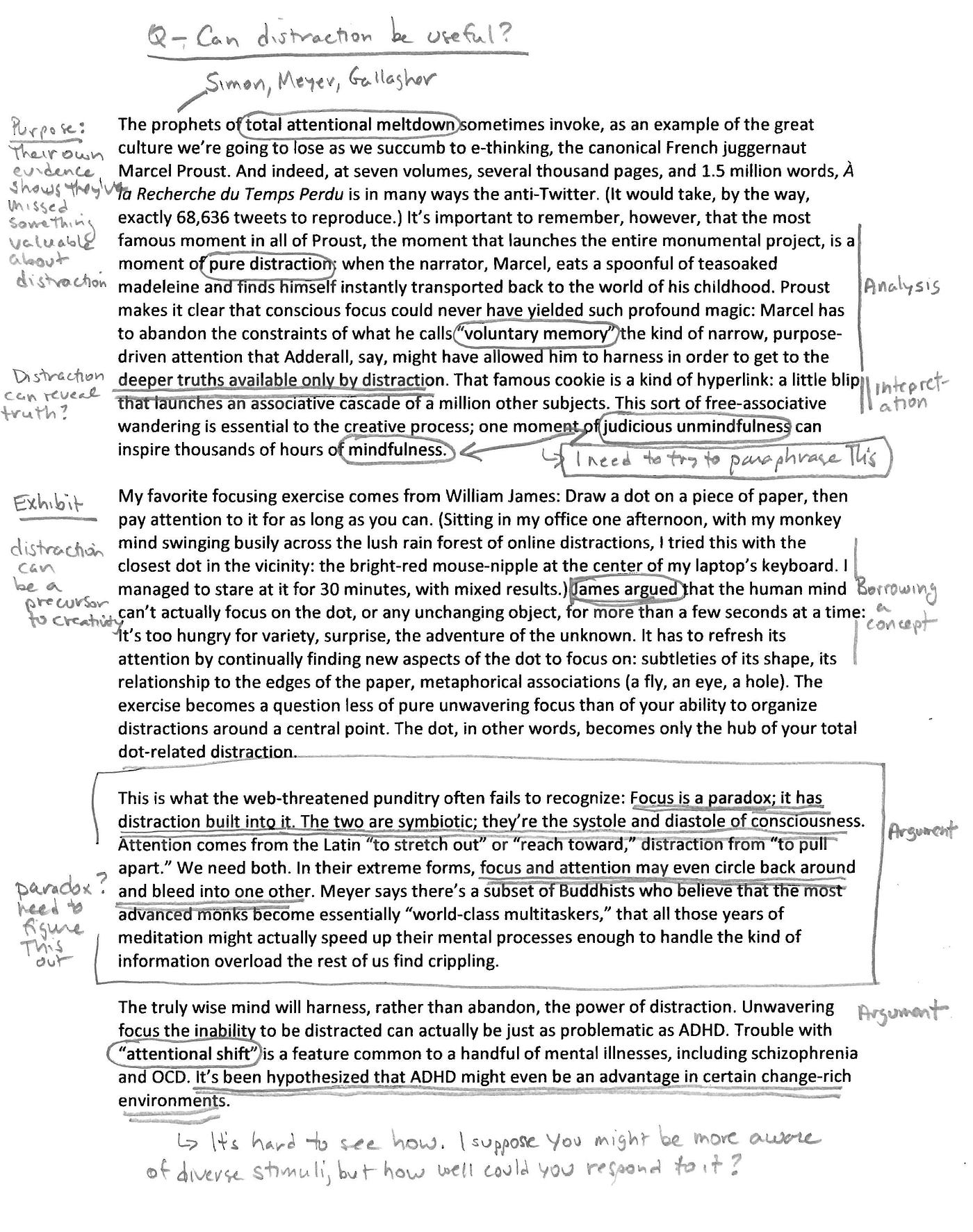
- Knowing that annotation is a powerful way to improve their reading comprehension, retention, and ability to respond
- Knowing how to chunk a complex reading into meaningful segments
- Having practiced summarizing the main idea of a chunk
- Having practiced distinguishing concepts from their examples
- Knowing that the Center for Writing & Speaking offers Reading Support
- Time allowing
- Learned how to see signal phrases, pivotal words, pointing words and echo links (scroll down to “Use Transition Words”), and voice markers to understand how ideas in a reading connect and the writer’s attitude towards the ideas they’re presenting
Resources
- How to Have Focused Reading Sessions in 75-90 Minutes
- Active Reading Process*
- Paragraph Purposes
- Pre-reading Activities*
- During-reading Activities
- Annotation – Marking Up Texts*
- Chunking & Summarizing*
- Reading for Concepts and Their Examples*
- Making Text-to-Text, Text-to-Self, and Text-to-World Connections
- Noticing Signal Phrases, Pivotal Words, Pointing Words and Echo Links (scroll down to “Use Transition Words”), and Voice Markers*
- Post-Reading Activities
- Summarize the core argument of the reading – focus first on the sequence of claims and why they’re important rather than the evidence in support of them, then respond to the argument using “Yes, and…,” “No, and here’s why not…” and “Okay, but…” sentence stems
- Write a paragraph in which you evaluate the evidence in support of the claims
- Make a John Bean What I Like/What Bother’s Me Idea Map to develop your response to a piece of writing
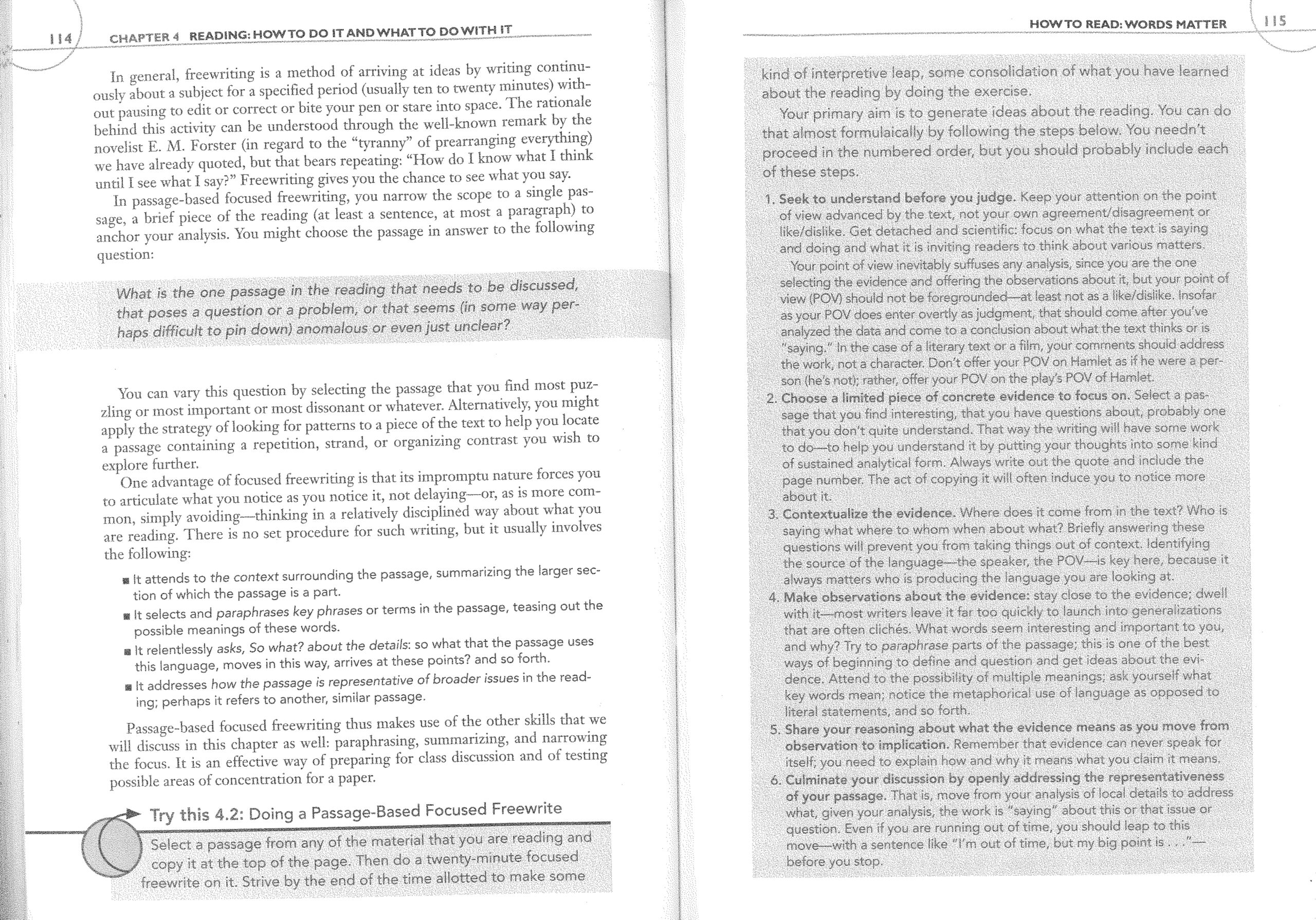
- Do passage-based focused freewriting exercises on hard-to-understand passages or on passages that seem worth exploring more in-depth
- Make a synthesis table to place multiple readings in conversation with one another
- Write informally in response to readings to improve your understanding
- Write and answer discussion questions
- Write to explore, test, complicate or challenge ideas
- Consider the issue, problem or question from another viewpoint, or through the lens of another reading
- Write extended definitions of keywords – include definitions written in your own words, examples, applications, and negative definitions (how the concept differs from similar or complementary terms)
- Summarize the core argument of the reading – focus first on the sequence of claims and why they’re important rather than the evidence in support of them, then respond to the argument using “Yes, and…,” “No, and here’s why not…” and “Okay, but…” sentence stems
- Malcolm Gladwell, “Small Change: Why the Revolution Will Not Be Tweeted” (pdf)
- Maria Konnikova, “The Limits of Friendship” (pdf)
This is what active reading looks like on the page
Workshop Text: Malcolm Gladwell, “Small Change: Why the Revolution Will Not Be Tweeted”